
THE THINGS WORTH OWNING
Fewer. Better. Kept Longer.

THE STANDARD · OBJECTS & CHARACTER · No. 01Words by A. Mercer
“The things worth owning are often the things worth keeping.”
There is a peculiar moment that occurs shortly after buying something new.
For a few days, perhaps weeks, you notice everything about it.
The leather is perfect. The watch crystal is spotless. The shoes have never seen rain. The car hasn't acquired its first stone chip. You place the bag carefully on the floor rather than simply setting it down.
And then life happens.
The watch meets the edge of a desk. The shoes encounter weather. The suitcase disappears into the hands of an airport baggage handler who appears to have a personal grievance against luggage.
The car acquires a scratch.
The leather darkens where your hand holds it.
And gradually, the thing you were so careful to preserve begins to show evidence that it has actually been used.
We have been conditioned to see this as deterioration.
Perhaps we have it backwards.
Because there are certain things that become less perfect with age—
and considerably better.
I. WE HAVE BECOME VERY GOOD AT REPLACING THINGS
Ownership once came with an assumption: you intended to keep it.
A pair of shoes could be resoled.
A watch could be serviced.
A coat could be repaired.
Furniture was refinished. Leather was conditioned. Cars were maintained.
When something broke, the first question wasn't necessarily What should I replace it with?
It was:
Can this be fixed?
Modern life has made replacement extraordinarily easy.
Something wears out—or merely begins to bore us—and within minutes we can be scrolling through its successor.
Newer. Faster. Slightly different. Arriving Tuesday.
There is nothing inherently wrong with progress. Some things genuinely improve as technology advances.
But somewhere between convenience and constant consumption, we began treating perfectly good possessions as temporary.
We own more things than generations before us and seem attached to fewer of them.
Perhaps ownership becomes more meaningful when replacement stops being the default.

II. BUY ONCE. MAINTAIN FOREVER.
This phrase is occasionally misunderstood.
It doesn't mean spending an absurd amount of money on everything you purchase.
Nor does it mean expensive automatically equals good.
It means buying certain things with a longer horizon.
Consider a mechanical watch.
Its technology is, objectively speaking, ridiculous. Your phone keeps better time. So does the microwave.
And yet a good mechanical watch can be opened, serviced, repaired and returned to your wrist decades after it was made. That changes the relationship.
You stop thinking about what replaces it next year.
You begin wondering whether your son might wear it someday.
The same principle applies elsewhere.
A properly constructed pair of leather shoes can be resoled. A substantial leather bag can survive decades of airports, trains and car boots. A fountain pen can remain on your desk long after dozens of disposable alternatives have disappeared.
A good coat can become familiar enough that winter feels slightly strange without it.
These objects aren't valuable merely because they last.
They become valuable because life happens while you're using them.
THE KEEPER'S LIST
Things worth buying with tomorrow in mind.
01 — THE WATCH
Mechanical. Serviceable. Timeless. Something that can accumulate decades rather than seasons.
02 — THE SHOES
Good leather. Proper construction. Repairable soles. Better after the hundredth wear than the first.
03 — THE WEEKENDER
Leather or substantial canvas. Something that looks better after Paris, New York and the trunk of a car than it did on the shelf.
04 — THE PEN
Simple. Refillable. Substantial enough that signing something important feels appropriately deliberate.
05 — THE BOOK
Hardcover when it deserves it. Write in the margins. Fold a corner. Return to it.
06 — THE EVERYDAY TOOL
Useful. Dependable. Built to perform the same task thousands of times.
07 — THE CAMERA
Not because your phone can't take a photograph. Because occasionally the act of taking one deserves your full attention.
08 — THE CAR
Not necessarily new. Certainly not necessarily expensive. Just something that makes taking the longer road occasionally seem reasonable.
III. REPAIRABILITY IS A FORM OF LUXURY
Luxury has become a strange word.
For many people, it means expensive.
For others, recognizable.
The logo. The packaging. The store. The waiting list.
There is another definition worth considering:
Luxury is being able to maintain something rather than continually replace it.
Look at how something is constructed before looking at what is printed on it.
Can the shoes be resoled?
Can the watch be serviced?
Can the bag be repaired?
Can the furniture be refinished?
Are replacement parts available?
Was the object designed with the assumption that someone might still care about it twenty years from now?
These questions are considerably less glamorous than asking which brand is fashionable.
They are also considerably more useful.

IV. PATINA IS NOT DAMAGE
Perfection has very little story. Age does.
Leather darkens.
Brass dulls.
Wood changes color.
A watch bracelet develops small scratches.
Shoes crease.
Denim fades.
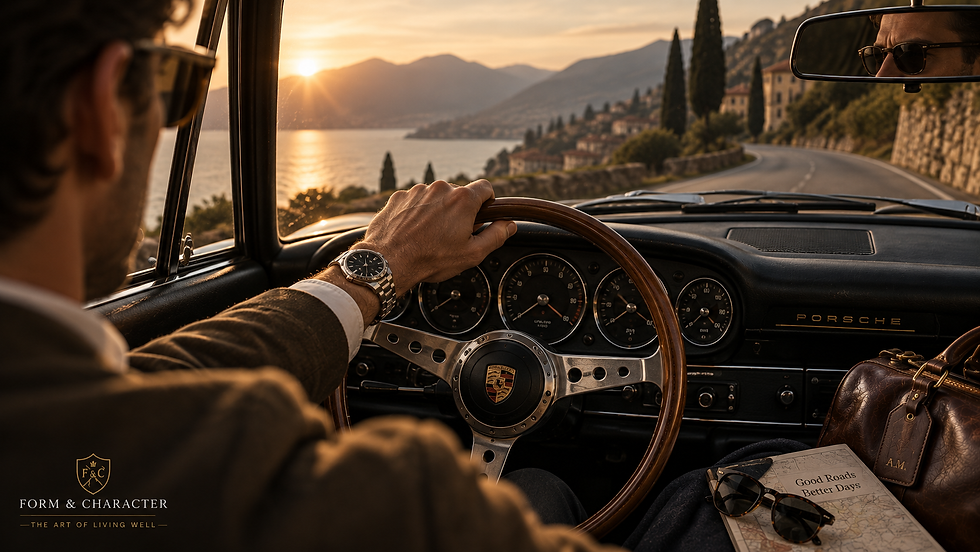
A steering wheel becomes smoother where thousands of miles have passed beneath your hands.
None of this would survive the quality-control department of a factory producing something new and yet we spend extraordinary amounts of money attempting to reproduce it artificially.
Furniture is distressed. Denim is pre-faded. Leather is deliberately aged. Watch manufacturers recreate designs from their archives. Hotels spend fortunes making brand-new rooms appear as though distinguished people have been sitting in them since 1927.
Why?
Because perfection has very little story.
Age does.
PATINA ≠ NEGLECT
PATINA
Scratches on a serviced watch.Creases in conditioned leather.Faded denim.A worn steering wheel.Marks from years of use.
NEGLECT
Water inside a watch because a seal was ignored.Leather cracking because it was never conditioned.Shoes destroyed because they were never maintained.A classic car without oil in the engine.
One tells a story. The other tells you to find a repair shop.
“Some things become less valuable when they're used. The best things become yours.”

V. USE THE GOOD THINGS
Many of us have something we're saving.
The good bottle.
The expensive shoes.
The watch reserved for important occasions.
The jacket that's too nice for an ordinary dinner.
The china that only appears when enough relatives have gathered to justify the risk.
There is prudence in caring for things.
But possessions can be protected so thoroughly that we forget their purpose.
The good shoes were made to be walked in.
The watch was made to be worn.
The car was made to be driven.
The luggage was made to collect baggage tags from places worth remembering.
Use them. Care for them afterward. Then use them again.
A perfectly preserved object may retain more monetary value.
An object woven into the memories of your life acquires another kind entirely.
VI. THE BEST THINGS COLLECT STORIES
Imagine two identical watches.
One remains inside its box for thirty years. The other belongs to a man who wears it nearly every day.
It is there when he gets married.
It is on his wrist when his children are born.
It travels with him.
It accompanies business successes and spectacular failures.
It sits beside hospital beds and birthday cakes.
It gets scratched moving furniture.
It gets serviced.
Perhaps the bracelet stretches slightly.
Thirty years later, the first watch may be in better condition.
But which one would his son rather inherit?
This is the part of value spreadsheets struggle to calculate.
Objects become interesting when they acquire provenance.
And provenance needn't involve a famous previous owner or an auction catalogue.
Sometimes provenance is simply:
My father wore this.
We bought this on our honeymoon.
I carried this bag on every important trip I ever took.
The monetary value may be irrelevant.
The story isn't.

VII. BUY FEWER THINGS
Quality costs money. Often, yes.
But buying better becomes considerably more realistic when combined with the first half of the philosophy:
BUY LESS.
You probably don't need six watches.
You may prefer one you genuinely love.
You don't need fifteen pairs of shoes occupying increasingly creative corners of the closet.
Perhaps five good pairs would do.
You don't need a new suitcase because the current one acquired a scratch in Rome.
That may be precisely why you should keep it.
When quantity decreases, the budget available for individual things can increase without spending more overall.
Before purchasing something, ask one question:
Can I imagine still wanting this in ten years?
Not whether it will physically survive ten years.
Whether you'll still want it.
That question eliminates an astonishing number of purchases.
VIII. EXPENSIVE IS NOT THE SAME AS GOOD
A philosophy of buying fewer, better things can very quickly become an excuse for buying unnecessarily expensive things.
That misses the point entirely.
Price is information. It is not proof.
A $5,000 watch isn't automatically five times better than a $1,000 watch.
A designer weekender covered in logos may be less durable than an anonymous leather bag made by a craftsman you've never heard of.
A $900 pair of shoes that doesn't fit is a considerably worse purchase than a $200 pair that does.
So what should you pay for?
Construction.
Materials.
Repairability.
Timeless design.
Companies willing to stand behind what they make.
And when it makes sense—
buy secondhand.
Someone else has already absorbed the depreciation.
You get the object.
They get the privilege of having removed the protective stickers.
Seems fair.
OWN THINGS WORTH KEEPING
Eventually, this philosophy becomes less about shopping than it first appears.
It is really about attachment. Care. Stewardship.
The willingness to maintain something after the excitement of acquiring it has disappeared.
We live in an era optimized for novelty.
New purchase. New car. New phone. New trend. New version.
New thing arriving Tuesday.
But a meaningful life cannot be constructed entirely from replacements.
Some things should remain.
The chair you always read in.
The pen you sign important things with.
The watch you instinctively put on every morning.
The battered bag waiting beside the door.
The books with notes written in their margins.
The car you occasionally turn around to look at after parking it.
None needs to be expensive.
They simply need to be worth keeping.
THE STANDARD
Buy fewer things.
Choose them slowly.
Pay for craftsmanship where craftsmanship matters.
Ignore prestige where it doesn't.
Maintain what you own.
Repair what can be repaired.
Allow leather to crease.
Allow watches to scratch.
Allow shoes to tell people you've actually walked somewhere in them.
Use the good things on ordinary days.
And don't become so concerned with preserving your possessions that you prevent them from participating in your life.
Because someday, the scratches may remind you of places.
The worn leather may remind you of journeys.
The book may fall open naturally to the passage you once needed.
And something you purchased simply because you liked it may eventually become something another person keeps because it reminds them of you.
That is a considerably more interesting definition of value.
BUY LESS.
CHOOSE WELL.
KEEP IT.
— A. Mercer
Keeper of the Standard
FORM & CHARACTER
The Art of Living Well.


Comments