
THE WELL-DRESSED MAN’S WARDROBE

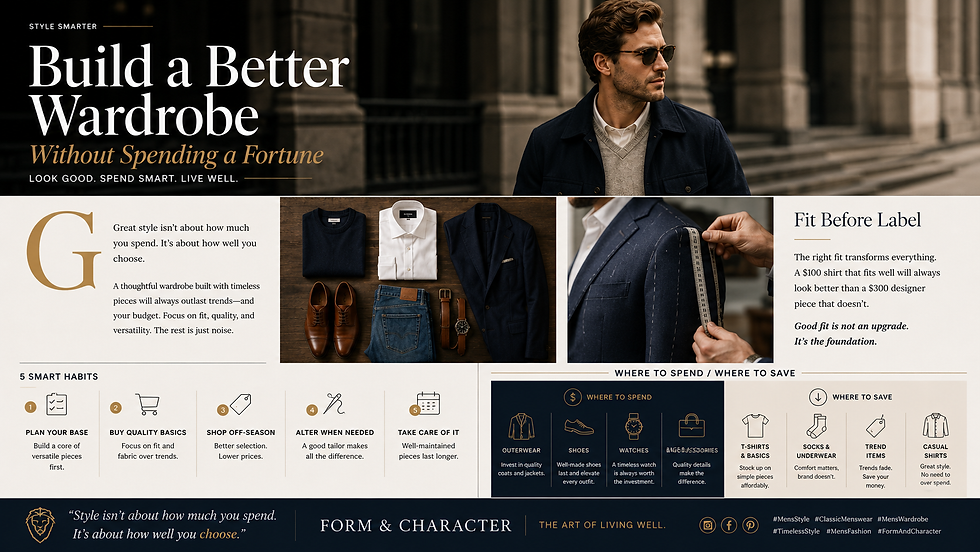
How to dress remarkably well without spending remarkably much.
STYLE · THE WARDROBE · No. 01
Words by A. Mercer
“Good style is purchased with judgment long before it is purchased with money.”
There is a persistent idea that dressing well is expensive.
It certainly can be.
There are suits that cost more than used cars, shoes that require several months to make, and watches whose prices are discussed more comfortably in the language of real estate.
None of them are required.
One of the great misunderstandings of men's style is the belief that looking well dressed is primarily a question of how much money one is willing to spend.
It isn't.
A $3,000 jacket that doesn't fit is still a jacket that doesn't fit. A designer logo cannot rescue poor proportions. And a wardrobe overflowing with expensive clothing is considerably less useful than a modest collection of things that work together.
The best-dressed men are rarely impressive because everything they own is expensive.
They are impressive because everything seems to belong.
The colors make sense. The proportions are right. The shoes are appropriate. Nothing is shouting for attention.
And perhaps most importantly, the man appears comfortable in all of it.

I. FIT BEFORE LABEL
The great equalizer of menswear.
If you remember only one thing, make it this:
Fit before label. Always.
Most people cannot identify the maker of your jacket from across the room.
They can, however, see that the shoulders are too wide.
They won't know what you paid for your trousers. They will notice that they're pooling around your shoes.
They probably won't recognize the brand of your Oxford shirt. They will recognize when the collar is two sizes too large.
Fit communicates something price cannot.
It makes inexpensive clothing look considered. And poor fit has the remarkable ability to make expensive clothing look cheap.
Start with the shoulders of a jacket. They should end roughly where yours do.
Pay attention to sleeve length. A small amount of shirt cuff beneath a jacket sleeve generally looks more intentional than sleeves swallowing the hand.
Let trousers sit where they were designed to sit. Avoid buying them unnecessarily large simply because a belt can technically keep them attached to you.
And find a tailor.
Not because every garment requires extensive alteration, but because thirty dollars spent correcting a trouser hem can improve your appearance more than another hundred dollars spent replacing the trousers.
THE MERCER NOTEThe cheapest upgrade in menswear is often removing an inch of fabric.

II. BUILD A WARDROBE, NOT OUTFITS
Men frequently spend too much because they shop for individual occasions.
An outfit for a wedding.
Something for vacation.
Something for dinner.
Something because it looked good on the mannequin.
Eventually the closet is full, yet somehow there is still nothing to wear.
The problem isn't quantity.
It's compatibility.
A useful wardrobe should behave more like a vocabulary. A relatively small number of pieces can create an enormous number of combinations because they were chosen to work together.
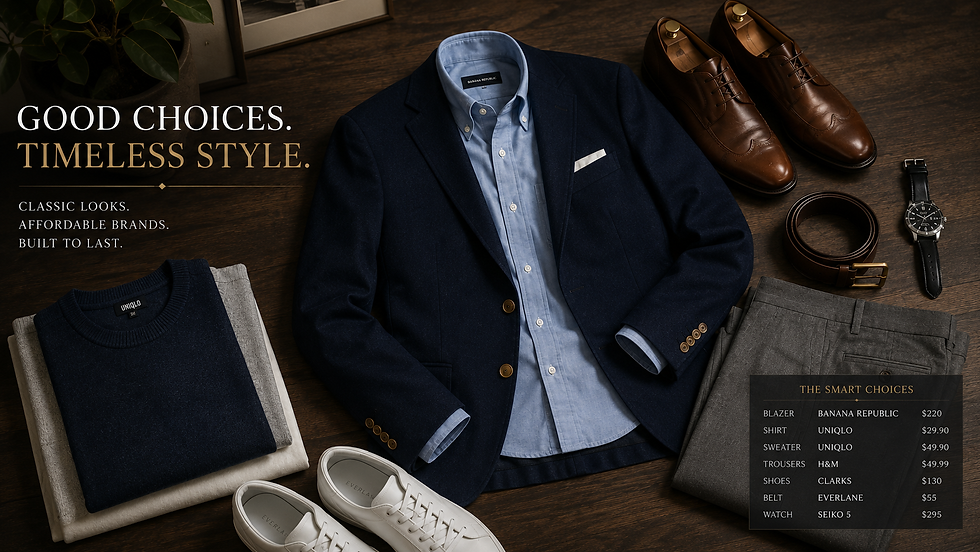
THE FOUNDATION
01 — Navy blazer
02 — Grey trousers
03 — Dark denim
04 — Khaki or stone chinos
05 — White Oxford shirt
06 — Pale-blue Oxford shirt
07 — Navy crewneck
08 — Charcoal knit
09 — Brown loafers or derbies
10 — Simple white leather sneakers
None of these pieces is particularly exciting alone.
That's precisely why they work.
The blazer works with nearly every trouser. The shirts work beneath the sweaters. The loafers work with denim, chinos and tailoring.
Instead of owning ten outfits, you begin owning possibilities.
III. BUY THE BORING VERSION FIRST
Personality works better after you've built the foundation.
There is a dangerous stage in developing personal style when a man discovers interesting clothes before he has acquired useful ones.
Suddenly there are patterned trousers. Unusual jackets. Bold shoes. Statement coats.
And still no decent navy sweater.
Resist this.
Your first suit probably shouldn't be green.
Your first proper overcoat doesn't require an enormous check.
Your only pair of loafers needn't be burgundy suede with tassels.
Begin with navy. Grey. Brown. White. Blue. Olive. Cream.
Colors that have been getting along with one another for generations.
Then introduce personality.
“Basics are not boring when they allow everything else to become possible.”
IV. WHERE TO SPEND — AND WHERE NOT TO
Not everything in your wardrobe deserves the same budget.
SPEND MORE CAREFULLY
Shoes — Construction and repairability matter.
Outerwear — A proper coat can serve you for decades.
Tailoring — Particularly pieces worn repeatedly.
Knitwear — Quality becomes apparent with wear.
Leather goods — Good leather generally improves rather than deteriorates.
SAVE WITHOUT APOLOGY
T-shirts
Casual shirts
Shorts
Seasonal pieces
Trend-driven items
Simple accessories
The principle is simple:
COST ÷ WEARS = VALUE
A $400 coat worn 100 times has cost you $4 per wear.
A $90 shirt worn twice cost $45.
Cheap clothing becomes expensive when you keep replacing it. Expensive clothing becomes wasteful when you don't wear it.
Value lives somewhere between the two.
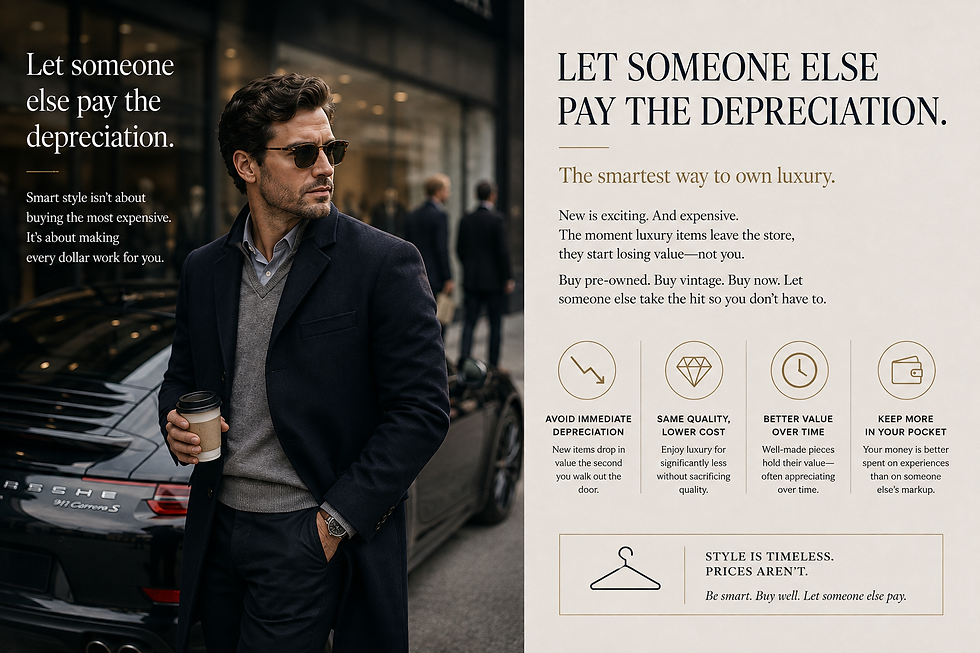
V. LET SOMEONE ELSE PAY THE DEPRECIATION
The case for secondhand.
Good clothing often improves with age.
Tweed softens.
Leather develops patina.
A quality overcoat remains a quality overcoat regardless of whether someone owned it before you.
And traditional menswear changes relatively slowly. Yesterday's excellent jacket often looks remarkably similar to today's excellent jacket.
Look at consignment stores. Vintage dealers. Estate sales. Reputable resale marketplaces.
Ignore the original retail price.
Examine the fabric. Inspect the seams. Check collars and cuffs. Make certain the shoulders fit.
And remember:
A $1,000 jacket reduced to $150 is not a bargain if you wouldn't have wanted it at $150 without seeing the original price.
The objective isn't acquiring expensive things cheaply.
It's acquiring good things intelligently.
VI. OWN LESS. MAINTAIN MORE.
There is another remarkably effective way to reduce the cost of dressing well:
Stop destroying your clothes.
-Brush your shoes.
-Use shoe trees.
-Hang jackets properly.
-Fold knitwear.
-Treat stains quickly.
-Don't unnecessarily dry-clean tailoring.
-Learn to iron a shirt.
-Repair the small hole before it becomes a large one.
There is something satisfying about maintaining an object rather than replacing it.
Eventually the leather creases where your foot bends. The jacket conforms to your shoulders. Denim fades according to how you actually live.
Your clothes stop looking like things you purchased.
They begin looking like yours.
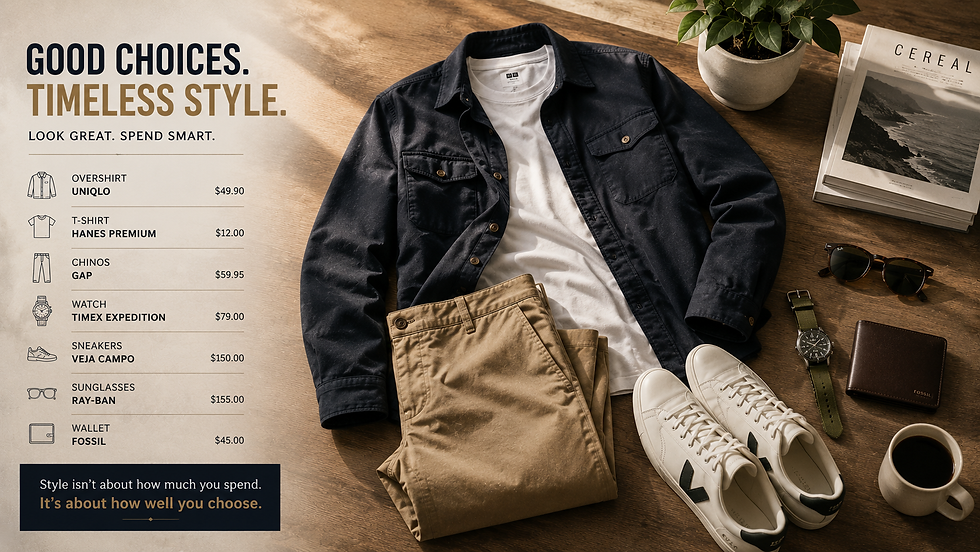
THE QUIET TRUTH ABOUT PRICE
Almost nobody knows what you paid.
That navy sweater? They don't know whether it cost $50 or $500.
Those trousers? Nobody knows.
The jacket? Perhaps an expert recognizes the fabric or construction.
Everyone else simply sees whether you look good wearing it.
We get ourselves into trouble when we confuse recognizable expense with recognizable taste.
Logos can tell someone what you spent.
Taste tells them why you chose it.
The latter is considerably harder to purchase.
VII. REPEAT YOURSELF
Some of history's most stylish men repeated themselves constantly.
They discovered what suited them and continued wearing variations of it.
There is confidence in repetition.
The navy blazer becomes your navy blazer.
You know which trousers work.
You stop wondering what shoes to wear.
Getting dressed becomes easier because you've removed unnecessary decisions.
This is sometimes called a personal uniform.
It isn't restrictive. It's liberating.
Style emerges when people remember the man before they remember the outfit.
VIII. THE MOST IMPORTANT THING TO LEARN
When not to buy.
Leave it there.
You don't need another shirt simply because it's on sale.
You don't need the jacket because someone online called it essential.
You don't need to replace perfectly good shoes because a slightly different shape has become fashionable.
Before buying something, ask yourself four questions:
01 — What will I wear this with?
02 — Would I want it if nobody knew the brand?
03 — Do I already own something that performs the same job?
04 — Am I buying this because I like it—or because buying something feels good today?
A wardrobe improves as much through what you refuse to add as through what you purchase.
Restraint is remarkably economical.

THE WARDROBE
You do not need fifty shirts. You need several that fit.
You do not need a wardrobe built in a weekend. In fact, you probably shouldn't have one.
Buy slowly. Alter what needs altering. Repair what can be repaired. Spend where craftsmanship earns its keep. Save where it doesn't. Learn your measurements. Learn your colors. Learn what you actually wear instead of what you imagine yourself wearing.
And give yourself permission to wear the good things often. Because the objective isn't to own a wardrobe that impresses someone when the doors open. It is to open those doors on an ordinary Tuesday morning and know that almost anything inside will work.
That is the difference between having clothes and having a wardrobe.
And it requires considerably less money than most men imagine.
It simply requires something money has always struggled to replace.
Taste.
— A. Mercer
Keeper of the Standard
FORM & CHARACTER
The Art of Living Well.


Comments