
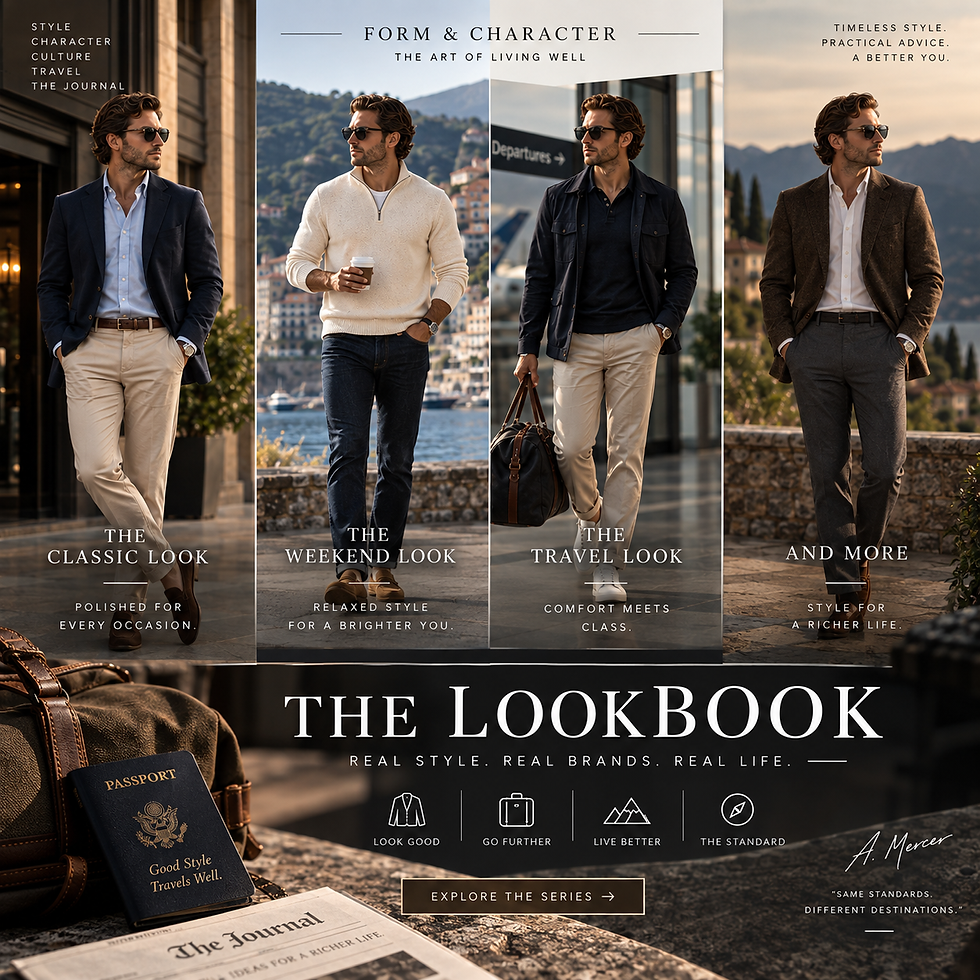
Three Looks. One Standard.

"Good style is not having something different to wear for every moment. It is knowing how to dress for the life you actually live."
THE JOURNAL · STYLE
Words by A. Mercer
There is a particular kind of man who appears to own an extraordinary amount of clothing.
At breakfast, he has the right sweater.
At dinner, the right jacket.
At the airport, somehow, the right trousers.
He arrives at a hotel looking as though someone has been carrying his luggage for him since birth and it would be reasonable to assume that his wardrobe occupies a room roughly the size of a small apartment.
Often, it doesn't.
The secret to looking consistently well dressed is rarely having more clothes.
It is having fewer wrong ones.
A good wardrobe is not a collection of outfits. It is a collection of pieces that understand one another.
The navy jacket works with the stone trousers.
The stone trousers work with the knit polo.
The knit polo works beneath the over shirt.
The loafers work on Friday evening and again on Saturday morning.
Suddenly twenty pieces of clothing become considerably more than twenty possibilities.
That is the wardrobe worth building. Not one designed for photographs. One designed for life. So, rather than discussing another list of things a man ought to buy, I thought we might do something more useful.
Three occasions. Three looks. And the principles that make each work.
I. THE CLASSIC LOOK
Polished for every occasion.
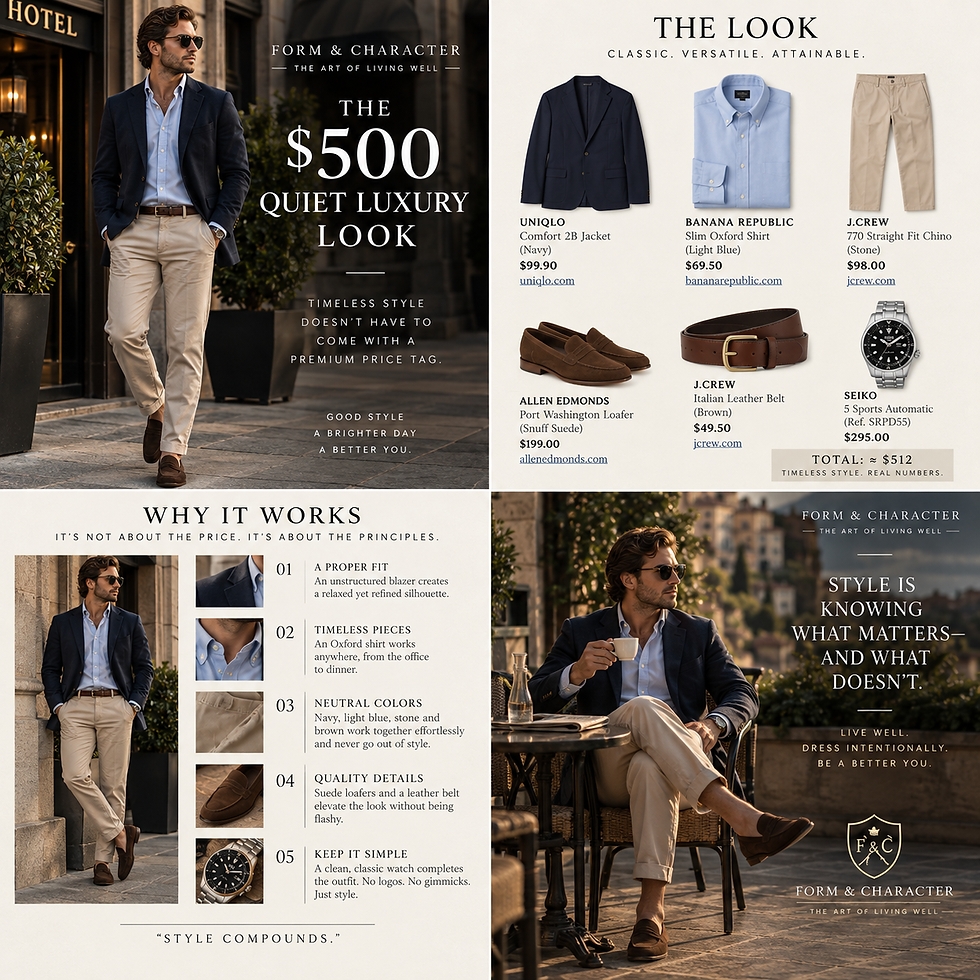
There are certain combinations that have survived long enough that attempting to improve them becomes almost arrogant.
A navy blazer.
A pale-blue Oxford.
Stone trousers.
Brown suede loafers.
That's it.
Nothing particularly revolutionary has happened here, and that is precisely why it works.
The navy blazer provides structure without the severity of a suit. The blue shirt softens the contrast. Stone trousers keep everything lighter and more relaxed. Brown suede brings texture without making the outfit overly formal. It can take you to lunch, a client meeting,
dinner, a wedding rehearsal, drinks at a good hotel, or almost any occasion where the dress code has been described using the increasingly unhelpful phrase smart casual.
The objective isn't to look expensive.
It is to look considered, and there is an important distinction.
A man wearing a $2,000 blazer that doesn't fit looks like a man wearing the wrong $2,000 blazer. A man wearing a $150 jacket that has been altered properly simply looks well dressed. Fit remains wonderfully democratic that way.
WHY IT WORKS
The colors have been getting along for generations.
Navy.
Blue.
Stone.
Brown.
There is almost nothing for you to get wrong and more importantly, none of the individual pieces is demanding attention. There is no enormous logo, no unusual pattern requiring the rest of the outfit to negotiate around it, no shoe attempting to become the subject of conversation, everything simply cooperates. That makes the outfit useful. Usefulness is one of the most underrated characteristics clothing can possess.
WHERE TO SPEND
If the budget is limited, spend your attention before spending your money.
Start with the blazer.
The shoulders should sit correctly. The body should follow your shape without strangling it. The sleeves should reveal a small amount of shirt cuff.
Then look at the trousers: The rise matters. The length matters. The taper matters. The name sewn inside matters considerably less.
Oxford shirts are available almost everywhere at sensible prices. So are chinos.
Suede loafers do not require an Italian surname to look good.
Buy the best versions your budget comfortably allows. Then take whatever money remains and visit a tailor. That last part will probably improve the outfit more than upgrading any logo on it.
The expensive-looking wardrobe is often just the properly fitting wardrobe.
II. THE WEEKEND LOOK
Relaxed is not the same as careless.
Weekend clothing presents an interesting problem. You want to be comfortable. Naturally.
But comfort has become such an unquestioned virtue that we occasionally dress as though Saturday has exempted us from civilization.
There is another option.
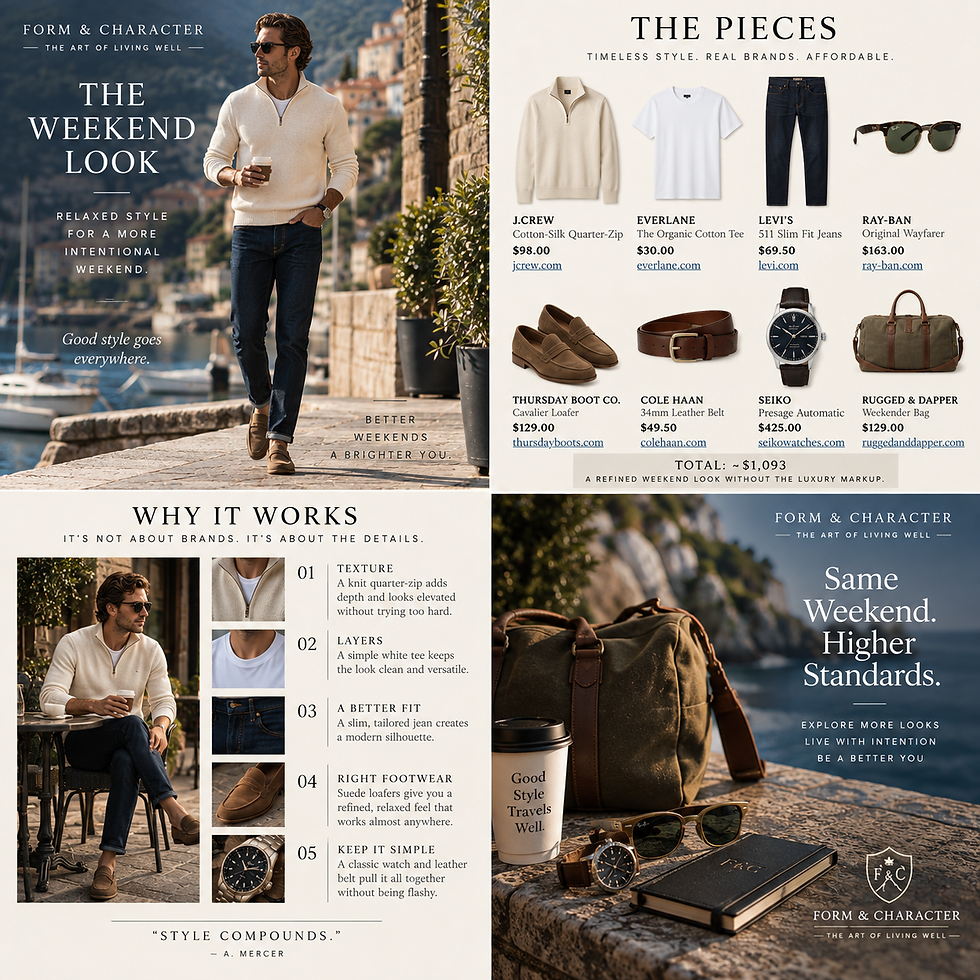
Cream quarter-zip. White T-shirt. Dark denim. Brown suede loafers. Sunglasses. Perhaps a watch. Nothing complicated.
The difference between this and the clothes you might wear while cleaning the garage is primarily intention.
The sweater has texture.
The denim is dark enough to remain versatile.
The shoes have structure.
The colors remain quiet.
It feels relaxed without looking accidental. That is the balance.
TEXTURE DOES THE WORK
Casual clothing becomes interesting when texture replaces formality.
A navy suit doesn't require much help. Its structure creates presence. A weekend outfit has less architecture, so the materials matter more.
Knitted cotton.
Suede.
Denim.
Leather.
These materials give the eye something to notice without introducing unnecessary color or pattern. This is why a cream knit over a plain white shirt can look considerably richer than a graphic sweatshirt costing three times as much.
One announces itself. The other relies on proportion and texture. I know which one I'd rather still own five years from now.
BUY THE UNEXCITING VERSION
This may be some of the most useful shopping advice I can offer. When purchasing wardrobe staples, buy the slightly boring one.
Not the jeans with the unusual wash. The dark ones.
Not the sweater with the enormous emblem. The plain one.
Not the loafers with the exaggerated sole because they happen to be fashionable this year.
The pair that would have looked appropriate ten years ago.
Boring clothes have an extraordinary ability to become interesting once combined with other good clothes and they age remarkably well.
The sweater doesn't need to make the outfit. You do.
III. THE TRAVEL LOOK

Comfort meets class.
Airports reveal things about people.
Mostly their willingness to stand directly in front of a baggage carousel despite their suitcase still being somewhere beneath Ohio. They also reveal how dramatically our expectations around travel have changed. There was once a time when people dressed for an airplane as though traveling itself were an occasion.
We do not need to return entirely to that.
A three-piece suit for seat 23B seems unnecessarily committed.
But perhaps there is a middle ground between Cary Grant and pajama trousers. I think there is.
A navy overshirt.
A knit polo.
Khaki or stone chinos.
Clean white leather sneakers.
A proper weekender.
Sunglasses.
A simple watch.
Comfortable enough for six hours in an airport.
Presentable enough that when you arrive, you don't immediately need to apologize to the hotel lobby.
TRAVEL CLOTHES SHOULD SOLVE PROBLEMS
This is where function matters. The over shirt provides pockets and an extra layer when the aircraft cabin inexplicably transitions from tropical to Arctic.
The knit polo remains comfortable but has enough structure to look deliberate. Chinos provide considerably more polish than sweatpants without making you feel like you're traveling to a board meeting.
Leather sneakers work with almost everything else you've packed. And the weekender?
Buy a good one.
Then stop worrying about keeping it perfect.
Let it travel.
Let the leather darken.
Let the canvas crease.
Let the baggage tag leave a mark.
A travel bag without evidence of travel is merely luggage waiting for a personality.
THE SECRET: THEY'RE ALMOST THE SAME WARDROBE
This is the part worth noticing.
Look at the three outfits again.
The classic look uses stone trousers. So does the travel look.
The weekend outfit uses suede loafers. So does the classic outfit.
Navy appears throughout. So does brown.
The watch doesn't change.
The belt doesn't need to change.
The sunglasses certainly don't.
This isn't accidental.
A wardrobe becomes powerful when the pieces begin doing more than one job.
The navy blazer can sit over the weekend T-shirt.
The cream knit can work with the stone trousers.
The travel polo can work beneath the blazer.
The white sneakers can replace the loafers on a casual day.
The Oxford can work beneath the weekend sweater.
Suddenly three outfits become ten. Then fifteen. Then you stop thinking in outfits altogether. You simply get dressed.
That is when a wardrobe begins working properly.
YOU DO NOT NEED THE EXACT BRANDS
There is a temptation with style guides to turn them into shopping lists.
Buy this jacket.
This shirt.
These trousers.
This watch.
And if you purchase everything correctly, presumably Cary Grant emerges from the parcel. Unfortunately, it doesn't work that way.
The brands we reference in our Look-book are examples, not requirements.
They demonstrate that the look can be achieved without entering luxury territory.
But perhaps you find the blazer secondhand. Good.
Perhaps the loafers are already in your closet. Better.
Perhaps your Oxford came from an outlet five years ago and fits perfectly. Keep it.
The objective is not replication. It is understanding.
Once you know why an outfit works, the label becomes considerably less important.
LET SOMEONE ELSE PAY THE DEPRECIATION
I remain an enthusiastic supporter of buying good things secondhand. Particularly jackets.
Shoes in appropriate condition, watches, leather goods. and certain pieces of outerwear.
There is a curious psychological barrier around used clothing that disappears remarkably quickly when the item originally cost $900 and is now hanging in front of you for $180.
Someone else had the pleasure of removing the tags and you've received the garment after the financially unpleasant portion of its life has concluded. A fair arrangement.
Vintage stores, consignment shops, resale platforms and outlet stores can build an extraordinary wardrobe if you know what you're looking for.
The important part is knowing what you're looking for before the discount convinces you that you need it.
A bad purchase at 70% off remains a bad purchase. Only cheaper.
STYLE IS KNOWING WHAT MATTERS
There is a reason these outfits look more expensive than they need to be.
They concentrate attention in the right places.
Fit. Proportion. Texture. Color. Condition.
The shirt is pressed.
The shoes are cared for.
The trousers end where trousers should end.
The jacket fits the shoulders.
The colors complement rather than compete.
None of those things requires wealth. They require attention, and perhaps that is why genuinely stylish men are difficult to identify by income alone.
Some men spend enormous amounts of money attempting to purchase taste.
Others learn what looks good on them, and the second group usually wins.
THE STANDARD
You do not need a wardrobe for every possible version of yourself.
Build one for the man you actually are.
A jacket that works when the occasion asks for effort. A sweater that makes Saturday feel slightly more considered, travel clothes comfortable enough for the journey and presentable enough for the destination. Good shoes, proper trousers, a few shirts, a watch you enjoy wearing, then stop chasing the idea that style is waiting somewhere inside the next purchase.
Wear what you own. Learn what works. Replace slowly. Upgrade deliberately. Tailor where necessary.
And remember that the objective was never to have people wonder how much your clothes cost.
It was to have them assume you knew exactly what you were doing when you put them on.
Three looks. One wardrobe. The same standard.
— A. Mercer
Keeper of the Standard
FORM & CHARACTER
The Art of Living Well.


Comments